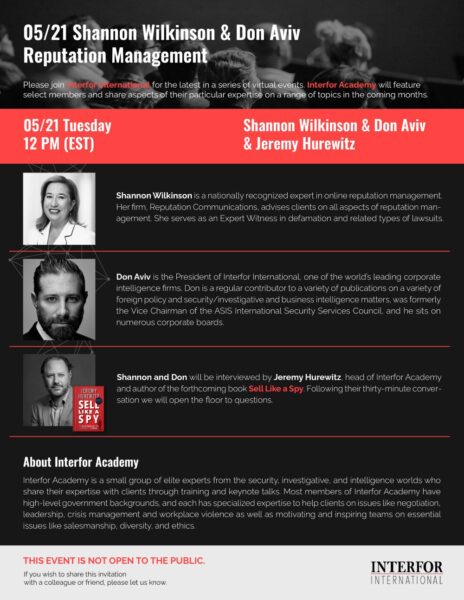

On May 21, 2024, Reputation Communications Advisory Board member Don Aviv, President of Interfor International, and I discussed a variety of ways to manage your reputation, assess the reputation of those you might do business with, and some common mistakes we encounter in these areas.
This was part of a continuing series of webinars presented by Interfor Academy, a new speaker’s bureau that enables organizations to book elite presenters for conferences, corporate off-sites, or risk trainings & tabletop sessions. The conversation will be moderated by head of Interfor Academy, Jeremy Hurewitz, and should be a compelling look at this vital and constantly evolving subject.
Reputation Communications publishes You(Online) to help educate CEOs, C-Suite executives, rising stars and high net worth individuals about online reputation management.
Reputation Reboot addresses real-life online reputation management (ORM) challenges faced by CEOs, executives, VIPs and their organizations. Unless they are public figures, their names and related descriptions of all individuals and companies discussed are changed to protect their privacy. For a quick look at the types of situations facing many professionals, scroll down and check out the headlines.
Online reputation management enables you to take more ownership over what appears about you on the Internet.
Without it, the world controls how you look online.
Here are ten examples of the ways online reputation management is used by individuals, companies and organizations.
To ensure up-to-date and accurate information dominates search results for an organization or individual’s name.
To ensure that factual, credible reference material is readily available online.
That reduces the chance that fraudulent information will impact a brand.
To remove unwanted or inappropriate information, photographs or other content from the first few pages of Google search results.
To monitor social media and online forums for red flags signaling potential on- and offline threats against high-profile individuals and their organizations.
To create a strong online presence about a topic.
That presence acts as a barrier against potential distortions from third-party content, including anonymous and defamatory material. Without it, such items can go straight to the top of searches – and stay.
To ensure that your story is told by you and not by former partners or other potentially biased parties.
To establish a reputation within your area of expertise on multiple online platforms.
To create an online legacy for a VIP who is preparing for retirement or to exit an organization.