
All posts by Shannon M. Wilkinson

About Shannon M. Wilkinson

Shannon Wilkinson is the founder and CEO of Reputation Communications.

Mindful Messaging Matters

As we’ve seen during the recent U.S. election and the COVID-19 crisis, it’s important to carefully consider any statements you make regarding hot-button issues. Recent history shows a wide variety of public figures have learned this lesson the hard way. Saints quarterback Drew Brees and FSU football coach Mike Norvell attracted blowback from statements they made after George Floyd’s death. Social media influencers such as @traderjoeslist creator Natasha Fischer and YouTube sensation Tana Mongeau also faced backlash for their responses to the crisis. With CNN’s Don Lemon and others calling out celebrities for being too cautious and declining to weigh in, public figures, brands and business leaders alike are realizing that sometimes silence is no longer an option.

To assure you are communicating in a meaningful and effective way, we recommend practicing good social listening and being mindful of the long-tail effect your words could have. As always, authenticity is key—and the best way to achieve that is through honesty and clarity. Avoid vague platitudes and superficial lip service. For an example of carefully considered messaging that still displays unmistakable integrity, read former Secretary of Defense James Mattis’ statement calling for unity, mutual respect and a renewed common purpose during a challenging time in U.S. history. It is evergreen.

 
 
reputation management tip

Last year, The Wall Street Journal published a riveting exposé about the online reputation tactics used by one agency for high-visible VIPs, from Washington appointees to hedge fund billionaires. 

If you are a high net worth or high visibility leader considering such services, it is an insightful read about the strategies used by many — but not all — agencies in this industry.

“Google removed five websites from Google News after The Wall Street Journal inquired about them. Google, owned by parent company Alphabet Inc., said the sites violated its policies around deceptive practices,” reported Rachael Levy.

That is just one take-away from the article. It is below the Journal’s paywall but well worth the price of a subscription to read.

More recently – in May – a second investigative piece, Google Hides News, Tricked by Fake Claims, came out in the Journal. As a result of the reporters’ in-depth analysis, Google replaced thousands of links to articles, legal notices and other content it had removed as a result of bogus copyright claims and manipulated removal requests.

Our takeaway: there are many false promises, claims and guarantees made in this less-than-transparent industry. As these articles show, it is best not to believe them all. If it sounds too good to be true, it probably is.

Related reading: Reputation Reboot: What Every Business Leader, Rising Star & VIP Needs to Know


Boston Private reputation management

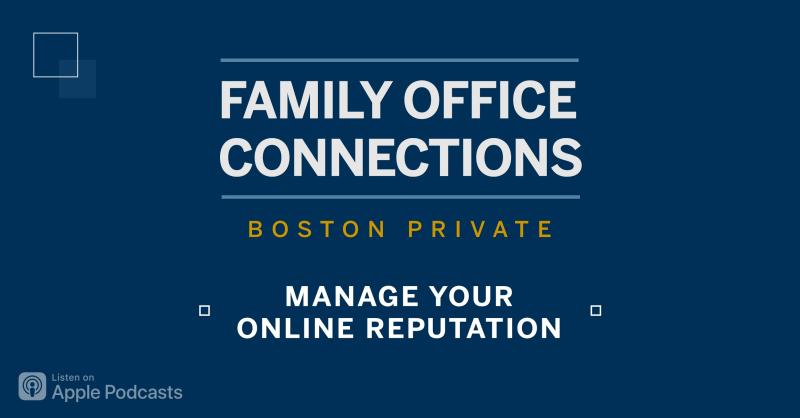
Edward Marshall, Managing Director at wealth management, trust, and private banking company Boston Private, recently interviewed me to discuss their new White Paper, Surveying the Risk and Threat Landscape to Family Offices.

In the podcast we discuss networks, risk management, partnering with the right vendors, and reputation management trends and concerns. I am pleased to share it with you here: Family Office Connections: Managing Your Online Reputation.

A family office is a privately held company that handles investment management and wealth management for a wealthy family, generally one with over $100 million in investable assets, with the goal being to effectively grow and transfer wealth across generations.

While my insights re serving high net wealth clients are highlighted in the podcast, so are online reputation management tips everyone can benefit from. I hope you will find it a helpful resource.


Reputation Communications

As we grapple with this “new normal,” one thing is clear: now we are all virtual.

Even after COVID-19 is under control, most of us will continue to promote our expertise and stature on the internet. We will have as many real-time video meetings as we are now. That, too, will be the “new normal.”

In this new world, your digital presence is the new you. Remember that, more than ever, you are who Google says you are. This is the perfect time for you to plan, evaluate and, if necessary, reboot your online reputation.

Here’s a brief checklist:

How is your personal branding website? How about your biography and, if you are preparing to pivot, your resume? Have you wanted to write articles, start a blog or contribute an Op-Ed piece to a major media outlet? Or to Medium, Jeff Bezos’ thought-leadership platform of choice? Have you mastered the teleconferencing platform Zoom? (If not, check out their filter that makes you look your best as well as their backgrounds, which display an image or video. You can also upload your own.)

As virtual reputation experts we offer these free resources to help you strategize: Digital Reputation Management for CEOs & the C-Suite. It’s short and to the point. We also have the ultimate insider’s guide, Reputation Reboot: What Every Business Leader, Rising Star and VIP Needs to Know.

For those of you who have wanted to engage our help in attaining an influential Google reset, we are fully operational. As always, we are here if you need us.

If you have high school or college students marooned indoors during this time, please be sure and have them do a thorough check of their social media posts. If they have ever shared or written posts that can be interpreted as being racist, sexist, or discriminatory, they may lose their future opportunities as interns, employees and college students. Our article, Inside the Social Media Screening Industry explains the risks they face.


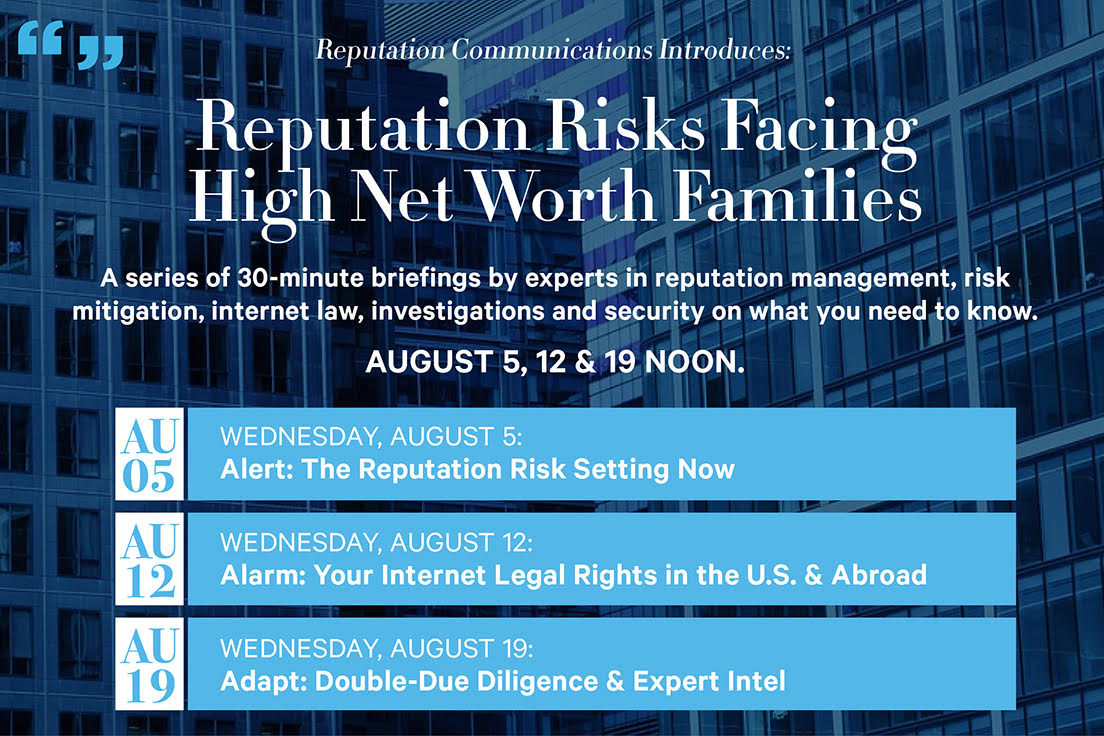
Reputation Risks Facing High Net Worth Families

In a digital world, everyone faces reputation risk. But high-net-worth families (HNWFs) and individuals face special scrutiny. 

Having served victims of such issues for a decade, Reputation Communications has organized a briefing to provide HNWFs with my own insight, as well as credible information from colleagues who are experienced in helping such families.

Please click here for full details and registration links.

Reputation Communications: Reputation Risks Facing High Net Worth Families


CDA 230

We rarely write about politics.

But President Trump’s attack on the legal loophole that allows online hate speech – Communications Decency Act, Section 230 — caught our attention. In short, he wants to do away with it.

We often lament the presence of the CDA 230, as it is known. In my recent article on Medium, I explain why:

On the internet, any of us can be impersonated, harassed or the focus of “fake news.” It persists because of the Communications Decency Act Section 230, a law that protects the platforms that publish such information — publishers like Google, Facebook, Twitter and millions of blogs, forums, and websites — against liability for third-party content on their websites.

We have helped many clients who have been adversely affected by the type of harassment the CDA 230 permits. So, we have been following this story with much interest. Why would President Trump want to remove that law? One reason: Twitter has been moderating his tweets and flagging content it considers questionable.

The New York Times described his intent:

The executive order that Mr. Trump signed on Thursday seeks to strip liability protection in certain cases for companies like Twitter, Google, and Facebook for the content on their sites, meaning they could face legal jeopardy if they allowed false and defamatory posts.

In another article, Times reporter Daisuke Wakabayashi explained how the CDA 230 works:

…Section 230 shields websites from liability for content created by their users. It permits internet companies to moderate their sites without being on the hook legally for everything they host.

Section 230 has allowed the modern internet to flourish. Sites can moderate content — set their own rules for what is and what is not allowed — without being liable for everything posted by visitors.

…Websites trading in revenge pornography, hate speech or personal information to harass people online receive the same immunity as sites like Wikipedia.

This topic will be in the news for weeks to come. Legal experts think it is unlikely that the CDA 230 can be substantially changed by President Trump’s action.  Our hope, like others who support updating it, is that it can be done through appropriate legislative channels.

Related reading: Removing Content from Google in the U.S.


Right to be Forgotten Law

In Europe, privacy is considered a human right. Online harassment is considered a human rights abuse.

In the U.S., there are few laws protecting us against having our personal data published online, or even collected and sold by data publishers. On the internet, any of us can be impersonated, harassed or the focus of “fake news.”

The personal and professional damages caused by online harassment can be so disruptive that my online reputation management practice supports bringing a version of the “Right to be Forgotten” to America—even though the CDA 230, the law that prevents that, is effectively the source of much of our business. We also support the passage of laws that will better protect the online privacy of U.S. citizens and protect them from anonymous harassment and other forms of hate speech, while through our business we find practical ways to protect them now.

My new article on Medium addresses the reasons why it is time to bring the “Right to Be Forgotten” here.

Read it here: The Case for Bringing the Right to be Forgotten to America.


Police chief's crisis management

Since the COVID-19 health crisis has swept the world, some elected officials have become famous because of their effective crisis communications response. People from all over the country and even different countries tune in to hear from Mayors and Governors that are not their own.

These are three traits these leaders share:

  • They are continuously sharing critical available data with the public.
  • They are using simple, straightforward language to deliver that data.
  • They are delivering their messaging in a setting that conveys trust, power, and leadership.

How can police chiefs take a page out of their playbook? The Hetty Group, interviewed me for my  top 3 tips, including communicating regularly and often; going virtual and why the optics matter. Read the article here.