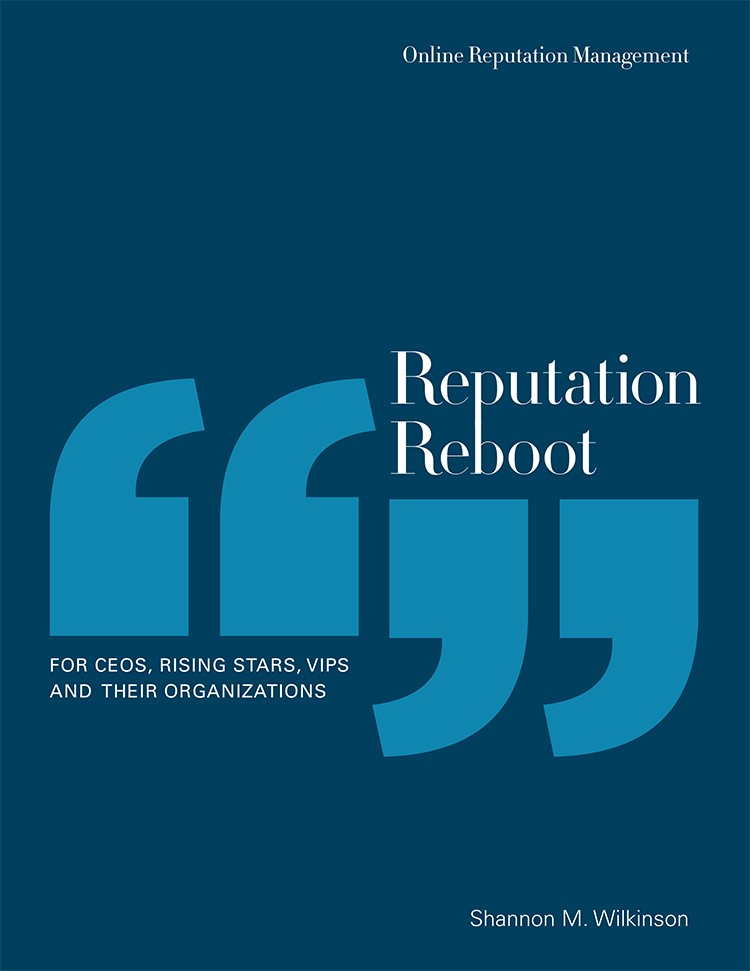
Our exclusive new guide to taking ownership of your online image is out. How to Look Better Online: Online Reputation Management for CEOs, Rising Stars, VIPs and Their Organizations was written by our founder, Shannon M. Wilkinson, in collaboration with our editing, content and design team.
How to Look Better Online draws upon our experiences improving and preventing the online reputation issues faced by a range of our clients. It is available as a downloadable eBook for all platforms. You can see a preview, learn more details and order a copy here.
What are a few of the most common mistakes CEOs and top executives make that can lead to reputation damage to them and their organizations?
Ms. Wilkinson: Many CEOs…they don’t own a lot of real estate in their name online, and they have not been proactive in creating a strategy to publish information about them on the Internet. When that happens the world creates your profile online, or Internet bots do. Whatever information third parties publish about you–whether credible or not, whether quality or not–will fill out the top pages of the Google search in your name and you have no control over that. The longer that stays the more difficult it is to replace it with more relevant information.
Are these the same issues they were dealing with a few years ago? How has the reputation risk landscape changed?
Ms. Wilkinson: The reputation risk landscape has gone through three developments. The first, which CEOs noticed around 2005, was the first wave of proliferation of anonymous malicious commentary that appeared widely on the Internet and was often directed toward companies, toward CEOs. The second wave was the proliferation of consumer reviews online, particularly geared toward customer service and complaints. The third phase we’re in now is the lack of privacy online, the continual spills of confidential in-house memos and emails, and of course the hacking.
What are some best practices executives and organizations can take to make it less likely they will fall victim to reputation slip-ups?
Ms. Wilkinson: The first is to look at the company’s internal culture. A lot of negativity comes from employees so it’s a good time to look inside at the opportunities employees have, and to look at diversity and inclusion, particularly providing women with opportunities. This is really the hot seat CEOs face now. This is going to be an issue for every company—employees, consumers are looking at how equitable companies are at providing opportunities for women, minorities, the LGBT group.
What makes top executives susceptible to engaging on social media in a way that can cause them reputation headaches?
Ms. Wilkinson: Some lack an understanding of how many people use social media and how they use it. I think most CEOs don’t encounter issues because of what they say on social media, it’s what is said on social media in response to their actions, that is the bigger threat. They’re so scrutinized and it’s so easy for a comment to be taken out of context.
Recent revelations about the NSA’s social media mining and analytic system have attracted much controversy. Many people don’t realize that a growing number of private companies use many of the same methods and have similar capabilities.
Such companies sell information to clients ranging from law enforcement and security companies to human resources departments and corporate intelligence firms. So it is critical to give some thought to strategies for managing your social media and other online activity. That is, if you are concerned with that activity (and your contacts) being collected, analyzed and possibly provided in reports to current or prospective employers, clients, partners and others.
Online investigative firms offer services ranging from basic social media screening, identification and verification to more extensive analysis and investigation, encompassing public records reports, deep Internet searches, social network mapping, activity monitoring, and resume vetting. On a broader scale, data from social media accounts and other online sources are also frequently scraped by automated bots, then aggregated and published by websites such as Intelius.com and USSearch.com.
Protecting your privacy
One way to protect your personal information is to stay off of social media entirely, or to limit your presence to a single trusted platform like LinkedIn. You can minimize the information that data mining companies obtain, while gaining greater control over what you do and don’t want to make available online.
Such a simple solution will work for some, but if abstaining from social media isn’t a viable option, a deliberate and cautious approach to managing your online image is necessary. Develop an appropriate strategy for managing your presence across all the platforms that you use.
Given the “new generation of programs that ‘revolutionize’ data collection and analysis” that are described by the New York Times, it’s also important to take a close look at what you may be revealing on social media in less obvious ways, such as through your network of connections, location metadata, and anything else that could be combined with public records and other available information to glean details about you. These pieces of data may seem obscure or inconsequential on their own, but with the advanced capabilities of the NSA and many private intelligence firms, you may be sharing more than you ever intended.
Today, Business Insurance published an article about how global expansion adds to companies’ reputational risks.
I was interviewed for the piece. An excerpt:
“While the speed at which information can travel through social media can enhance reputation risk, social media can be a valuable tool in managing reputation risks, said Shannon M. Wilkinson, CEO of Reputation Communications in New York. Social media audits can provide important information before a company enters a market, she said.
“Social media provides a barometer into all those kinds of things,” she said. “It can be done quickly. It can be done cheaply.”
Such social media research can provide information on perceptions of products, companies or marketing campaigns, as well as an opportunity to learn from competitors’ experiences, Ms. Wilkinson said.
“They can go to Twitter and they can see what their peer group’s doing,” she said. “It’s a very good way of observing best and worst practices.”
It also can provide information on whether signing a particular celebrity spokesperson might be a big reputation risk mistake.
“He might be a face for a different kind of product, but not in this area,” Ms. Wilkinson said. “All of this is researchable and it’s not so much about making a judgment; it’s about determining what is the most appropriate affiliation for your company or your product launch.”
Sallie Krawcheck is a top candidate to become the next head of the SEC, according to Dealbook, but it’s not just her record and resilience as a Wall Street executive that’s put her in the running.
Since she began tweeting last spring, Krawcheck has gained more than 11,000 followers. On LinkedIn she’s attracted an even larger audience—75,000 and counting. “She has drawn a significant following with her conversational style and posts on investment issues,” Dealbook says, referring to an earlier article in which Krawcheck called her move “part of a larger effort to style herself as an industry analyst” and “lend her Wall Street experience to the broader debate about the industry’s evolution.” Already among LinkedIn’s top “Thought Leaders” and Business Insider’s “101 Finance People You Have To Follow On Twitter,” she’s clearly had a great deal of success with her strategy.
Social Media Savvy
A big part of that success comes from Krawcheck’s deft use of social media to take ownership of her image and message. In the past, she would have had to rely on a public relations intermediary to arrange interviews and keep her name out there, as many prominent figures do. However, she has used social media to take more direct control of her voice and reach a larger audience at the same time. In a recent RIABiz.com article Dina Hampton examines how Krawcheck “used those months of technical unemployment to cultivate a distinct and intimate online voice that may, industry watchers say, deftly position her for her next move.” Speaking to Hampton, Gregory FCA Communications’ Joe Anthony adds that Krawcheck’s strategy has “broadened her footprint to where more people are recognizing her beyond the financial services space” and “gone from being seen as a sharp mind within wealth management/banking to a thought leader and business titan.”
While she may describe herself in her Twitter profile as a “current mom” and “crazed UNC basketball fan,” a closer look at Krawcheck’s online presence shows that her approach is far from amateur. In addition to regularly sharing useful links and poignant thoughts on both Twitter and LinkedIn, she has self-published popular posts like “Lessons Learned in Leading During a Crisis” and “What I Learned When I Got Fired (the First Time)” and penned op-eds for outlets including the Wall Street Journal, Washington Post and Politico.
Those posts have given her a chance to share her own perspective and narrative regarding her previous experience, while the op-eds appear to be setting the stage for her next move. “Lately Krawcheck has been peppering the media with her thoughts and strong recommendations about how to address, if not solve, the gigantic, chronic, almost genetic, ills of the global financial industry,” The Daily Beast’s Allan Dodds Frank wrote in October. “If she can continue her nonpartisan stance,” Frank observed, “she might be the ideal person to be in charge of consumer protection, be nominated to the Securities & Exchange Commission or to a Treasury Department job.”
Setting the Stage
Her undergraduate degree at the UNC School of Journalism has likely helped Krawcheck communicate effectively, but perhaps more important is how she has applied the same strategies that made her one of Wall Street’s top female executives to her social media endeavors. “The secrets of Krawcheck’s success, however, hinge on her social skills,” Heidi N. Moore wrote in 2009, adding that “she has built a reputation as Mrs. Clean” and combined “a warm interest in others’ feelings, an obsession with preparation” and with “frank talk and open ambition.”
Speculation about where she’ll end up next will surely continue, and there’s no guarantee that she’ll be tapped as the next SEC chair. But one thing is certain: as one of the first major names in the banking world to dive headfirst into social media, Sallie Krawcheck has reaped the vast potential of an open and savvy online strategy.
About You(Online)
Reputation Communications publishes You(Online) to help educate CEOs, C-Suite executives, rising stars and high net worth individuals about online reputation management.
Reputation Reboot addresses real-life online reputation management (ORM) challenges faced by CEOs, executives, VIPs and their organizations. Unless they are public figures, their names and related descriptions of all individuals and companies discussed are changed to protect their privacy. For a quick look at the types of situations facing many professionals, scroll down and check out the headlines.
Online reputation management enables you to take more ownership over what appears about you on the Internet.
Without it, the world controls how you look online.
Here are ten examples of the ways online reputation management is used by individuals, companies and organizations.
To ensure up-to-date and accurate information dominates search results for an organization or individual’s name.
To ensure that factual, credible reference material is readily available online.
That reduces the chance that fraudulent information will impact a brand.
To remove unwanted or inappropriate information, photographs or other content from the first few pages of Google search results.
To monitor social media and online forums for red flags signaling potential on- and offline threats against high-profile individuals and their organizations.
To create a strong online presence about a topic.
That presence acts as a barrier against potential distortions from third-party content, including anonymous and defamatory material. Without it, such items can go straight to the top of searches – and stay.
To ensure that your story is told by you and not by former partners or other potentially biased parties.
To establish a reputation within your area of expertise on multiple online platforms.
To create an online legacy for a VIP who is preparing for retirement or to exit an organization.